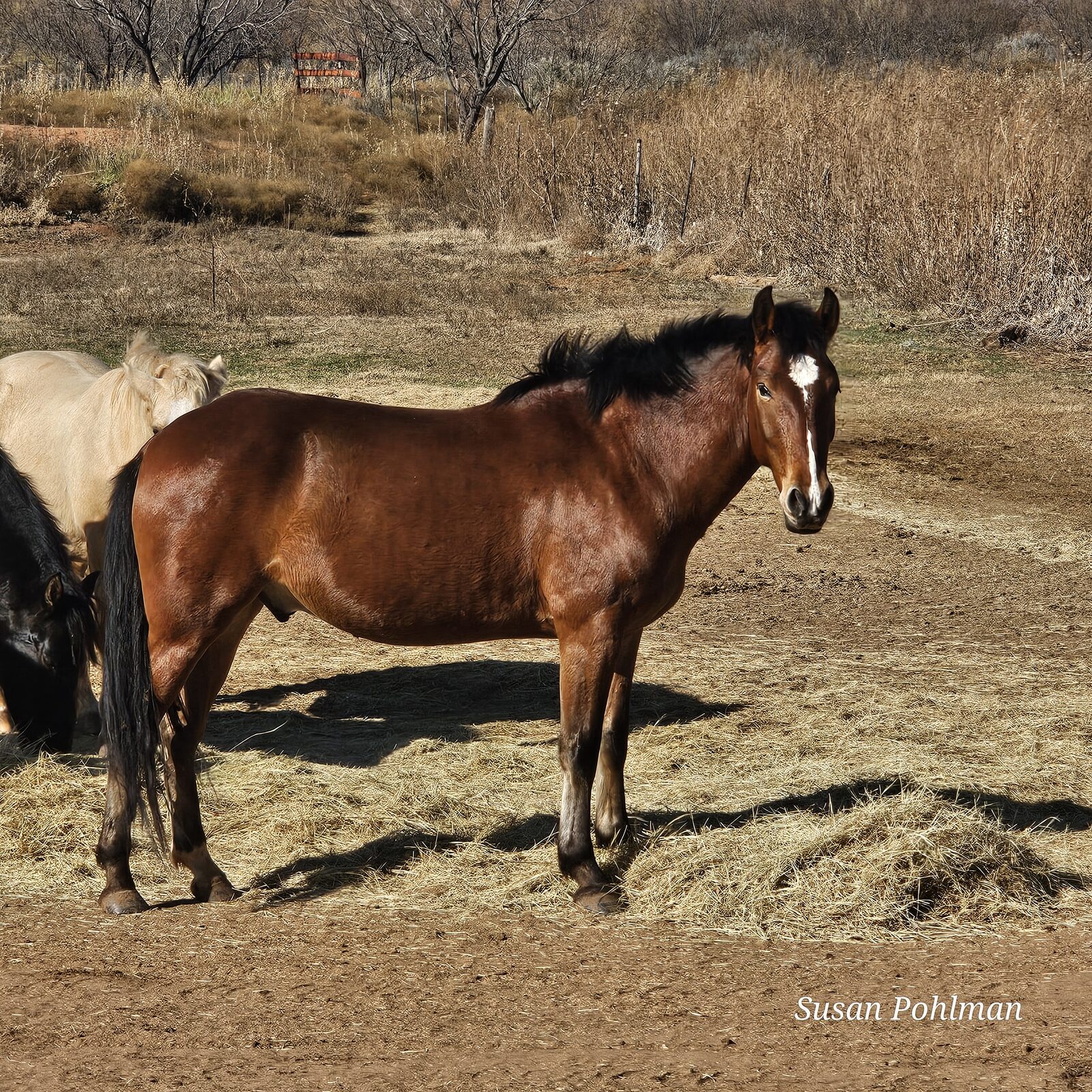
Before Whispering Winds was a quiet sanctuary, it was the front line of a fight for America's wild horses.
In 2000, Susan and Tom Pohlman attended their first BLM wild mustang adoption. "The horses just have something about them," Susan says. "They're raw. Domestic horses are so used to being around people, and having things done for them. Mustangs have to troubleshoot for themselves — they're smarter for it." That first adoption changed the direction of their lives.
What started as adopting and gentling their own mustangs grew into something much bigger. Susan became an active member of the Alliance of Wild Horse Advocates, working alongside other organizations across the country to help place, foster, and transport wild horses that had been rounded up off public land — horses that, once labeled "unadoptable" by the Bureau of Land Management, had almost nowhere else to go. In 2007 alone, she helped place or take in over 250 horses nationally.
"Wild horses galloping across the vast plains of the West is an image that has long been associated with the spirit and freedom of America. However, as a nation, we have herded them, broken them, and sent them to slaughter." — Susan Pohlman
The largest single rescue in the sanctuary's history came in December 2007, when a truck carrying 33 mares arrived at the ranch in the dead of winter. These were the Nevada Range horses — wild mares that had been gathered off the range and placed into a university fertility-control research program, injected with experimental drugs as part of an effort to manage wild horse populations. When funding for the study ended, the horses were headed for a feedlot, and ultimately slaughter, unless someone stepped in.
Susan and Tom took in all 33. Seven were discovered to be pregnant. Of the foals born, only three survived — including a colt named Carson, rejected by his mother at birth and given almost no chance of surviving his first night. He lived to be one of the sanctuary's most beloved horses for the next fifteen years.
Alongside the Nevada Range mares, Whispering Winds took in wild horses from several other difficult situations: the Piute herd, gathered off tribal land and bound for a slaughter-holding pen in Fallon, Nevada, before a fundraising effort bought them a way out; horses from the Sheldon National Wildlife Refuge, descendants of U.S. Army Remount stock, pulled back at the last moment from a truck already headed to slaughter; and BLM "three-strike" horses — mustangs passed over at three separate adoption events and, as a result, formally reclassified as unadoptable, leaving the kill pen as their only realistic outcome.
At its peak, the ranch was home to roughly 80 horses, the large majority of them mustangs, organized into their own bands: the Paiute herd, the BLM mustangs, the Nevada Range horses, and the Sheldon horses.
For nearly a decade, Susan was one of the more vocal wild-horse advocates in the Pacific Northwest — testifying to what she witnessed in the gathers, the holding facilities, and the fertility studies, and working to place as many horses in safe, permanent homes as she possibly could. Whispering Winds worked to help end horse slaughterhouse operations in Oregon during this period, even as the overseas slaughter pipeline through Canada and Mexico continued to grow.
Slowly, patiently, every horse who could be safely placed in a new home was rehomed. What was left, by the time the numbers came down to around 30, wasn't a leftover population — it was the hardest core of the herd: horses too old to start over, horses with permanent injuries or blindness, unhandled mustangs who would never be safe to place with an inexperienced owner, and bonded pairs who needed each other more than they needed anything else.
That's the herd that moved to Roby, Texas in 2016, and that's the herd — grown now to include horses of many other breeds and backgrounds, all in need of the same kind of permanent, patient care — that lives at Whispering Winds today. The fight for freedom looked different in 2007 than it does now. Today, it looks like thirty-some quiet acres in West Texas where nobody's freedom is ever up for a vote again.
